For one year, he worked with Richard Whitcomb of NASA Langley, known for supercritical wing design, winglets and Coke bottle fuselages. This work involved optimal engine and airframe integration of PWA engines with Airbus jumbo jets, with Whitcomb addressing flight test results. Several years later, he joined MITRE Corporation and NASA Johnson Space Center in Houston, directing efforts aimed at streamlining systems operations. Wilson would author Modern Aerodynamic Methods for Direct and Inverse Applications, the award-winning book from John Wiley & Sons, New York, 2019, and earlier, had published extensively with AIAA Journal, Journal of Aircraft, Journal of Hydronautics and ASME Journal of Applied Mechanics. In 2023, Wilson was the BakerHughes (Fortune 200) nominee to the United States National Academy of Engineering. Visit the author at www.stratamagnetic.com or correspond by email at stratamagnetic.software@outlook.com. Wilson C. Chin earned his Ph.D. from the Massachusetts Institute of Technology (MIT) under Professor Marten Landahl, the aerodynamicist synonymous with seminal contributions to unsteady transonic flow. He was affiliated with the MIT Aerophysics Laboratory, an early leader in hypersonic wave rider design. Earlier, he obtained an M.Sc. from the California Institute of Technology (Caltech) with Professor Gerald Whitham, developer of modern sonic boom theory. Both degrees were in Aerospace Engineering. On graduation, Wilson would serve as Senior Aerodynamicist with Boeing, shortly thereafter, joining Pratt & Whitney Commercial Jet Engine Division as Turbomachinery Manager.
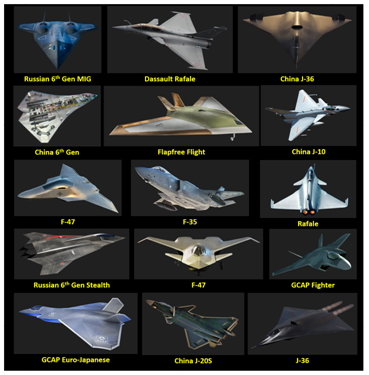
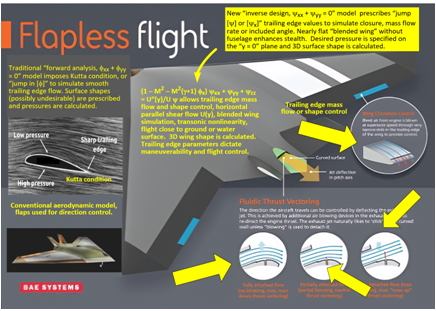
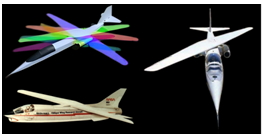
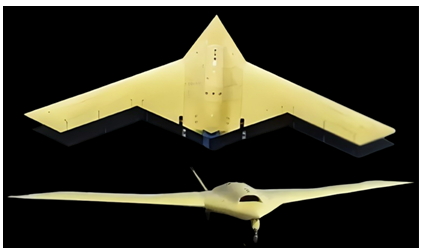
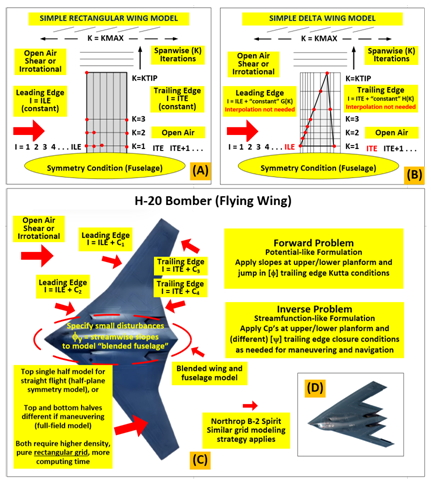
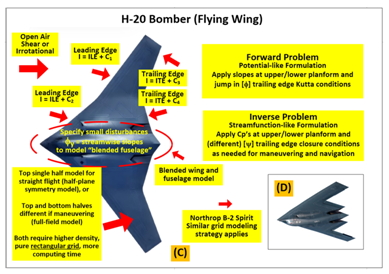
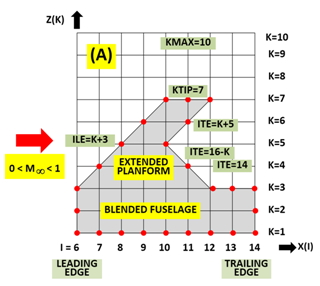
Sixth Generation bombers and drones reduce radar cross-section by replacing fuselages with lifting blended fuselages, avoiding tails, canards and fins where possible. Delta and lambda planforms ensure low drag supersonic flight, but nonetheless, such wings must navigate safely through subsonic and transonic zones. Wings are flapless to reduce mechanical complexity and visibility to radar. Directional control is facilitated by high speed jets emerging from trailing edges. These must be designed using inverse methods. For example, desired wing surface pressures are specified, but the shapes inducing prescribed pressures are not unique. As many shapes exist as there are different degrees of edge closure. And that is a lot.
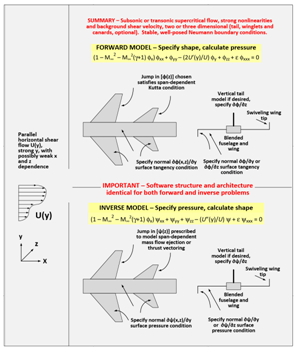
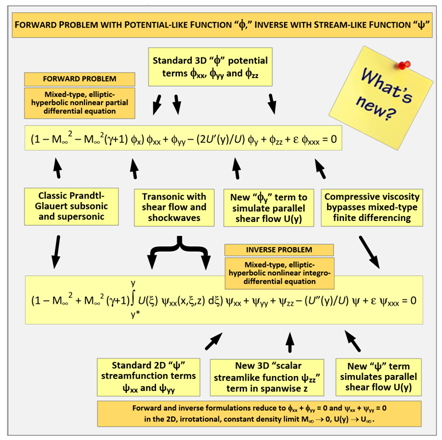
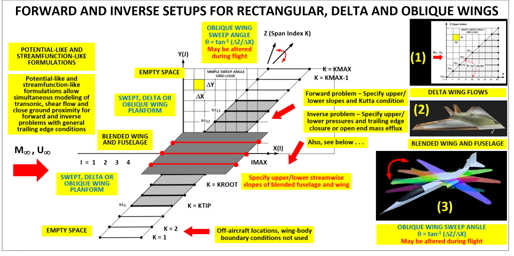
What is worse, radar evasion and low altitude take-off and landing through aircraft carrier wakes mean that strong background boundary layer shear flows are present. The implication? Conventional potential and streamfunction formulations do not apply, thus requiring cumbersone Euler and Navier-Stokes methods that are, in practice, no more accurate. We have developed potential-like and streamfunction-like methods that are mathematically rigorous, rapid, stable and convenient to use. And all of our shear flow methods apply to three-dimensional transonic supercritical flows with shocks.
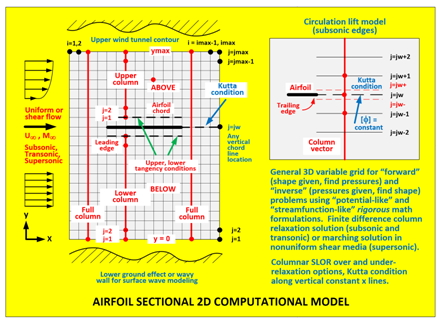
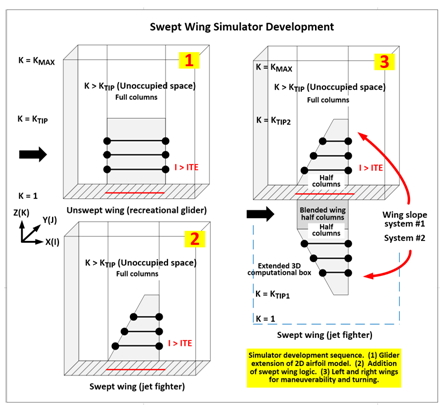
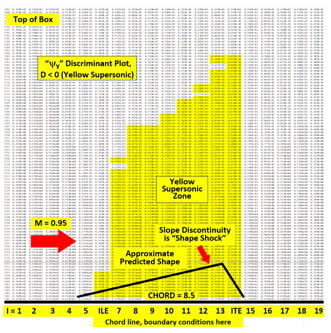
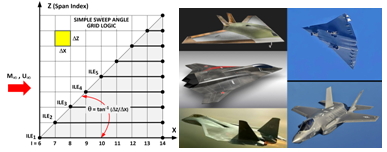
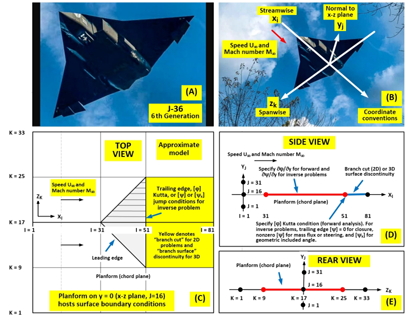
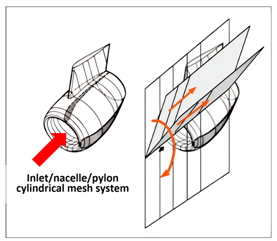
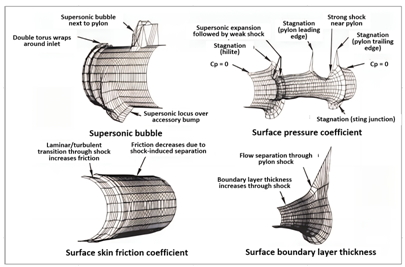
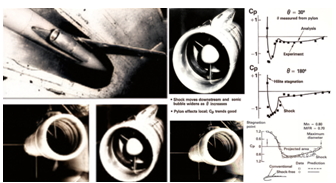
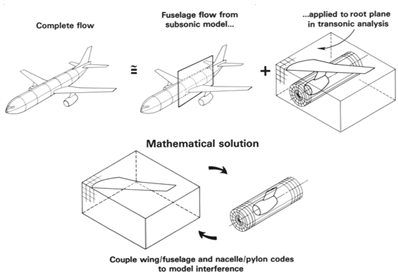
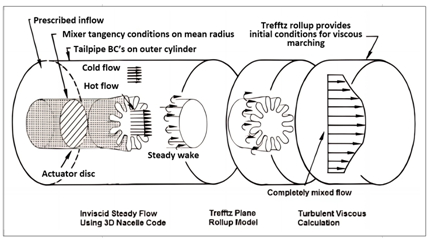
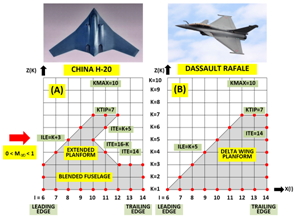
The overview slides shown below are duplicated from our latest aerodynamics book, Aerodynamics for Sixth Generation Aircraft Design, John Wiley & Sons, New York, Q3 2026. Pre-publication copies are available from this website and online tutorials may be arranged.
Contact us at stratamagnetic.software@outlook.com, or phone (832) 483-6899 in the United States, +86 133-8131-0233 in Hong Kong and China, and +234 903 334 5823 in Nigeria and the African continent.
About Us
Home | Team Members | Papers | Patents | Books | Brochures | Contact |
Research, Science and Engineering
Home | Measurement While Drilling | Formation Testing | Fluid Rheology | Managed Pressure Drilling | Reservoir Engineering | Electromagnetic Modeling | Waves and Vibrations | Aerodynamics | Biomedical Imaging |
Copyright (C) 2025, by Stratamagnetic Software, LLC. All rights reserved.
ADVANCED AERODYNAMICS
Consult our new book on Sixth Generation aircraft design for more information. Click Preface or Table of Contents. Pre-publication book copies at Highlights (140 pages, with three dozen applications examples) or Full manuscript, with theory and algorithms (500 pages) .